An agent that builds — and verifies — its own game.
PawnSim colony-sim · two media skills · human-in-the-loop ops · $0 runtime · EN + KO
AI-PoweredSelf-EvolvingAutonomous
The active work is PawnSim — a colony-sim vertical slice the agent builds and play-tests in a tight loop, where the headline isn't features but verification: code existing ≠ verified working. A production media skill (music-video) ships alongside a parked one (job-hunt), every mechanical stage stays local at $0 runtime cost, and the repo audits itself on every commit.
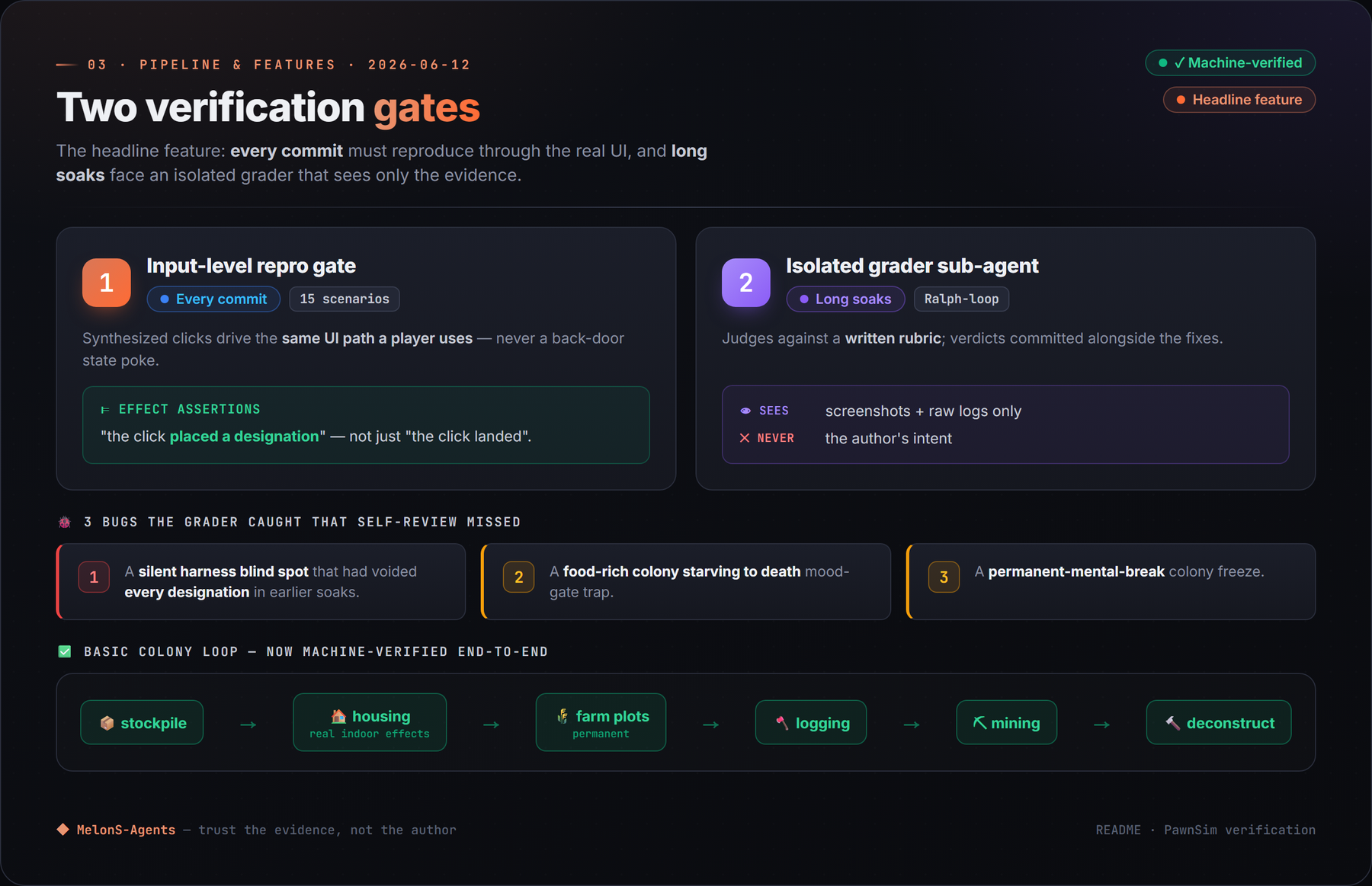
Every commit is gated by a 22-scenario input-level repro test — synthesized clicks through the player's own UI path, asserting the effect, not just that the click landed.
Long unattended soaks are judged by an isolated grader sub-agent against a written rubric — it sees only evidence (screenshots + raw logs), never the author's intent.
Two media skills: music-video (a track → a 9:16 short with phrase-aware cuts + 23 vintage shaders) and job-hunt (one seed keyword → a deduplicated Korean job-board digest — parked, KR boards now block scraping).
Mechanical stages stay local (Unity batchmode, aubio, whisper.cpp, ffmpeg); creative stages opt into Claude under the operator's existing subscription.
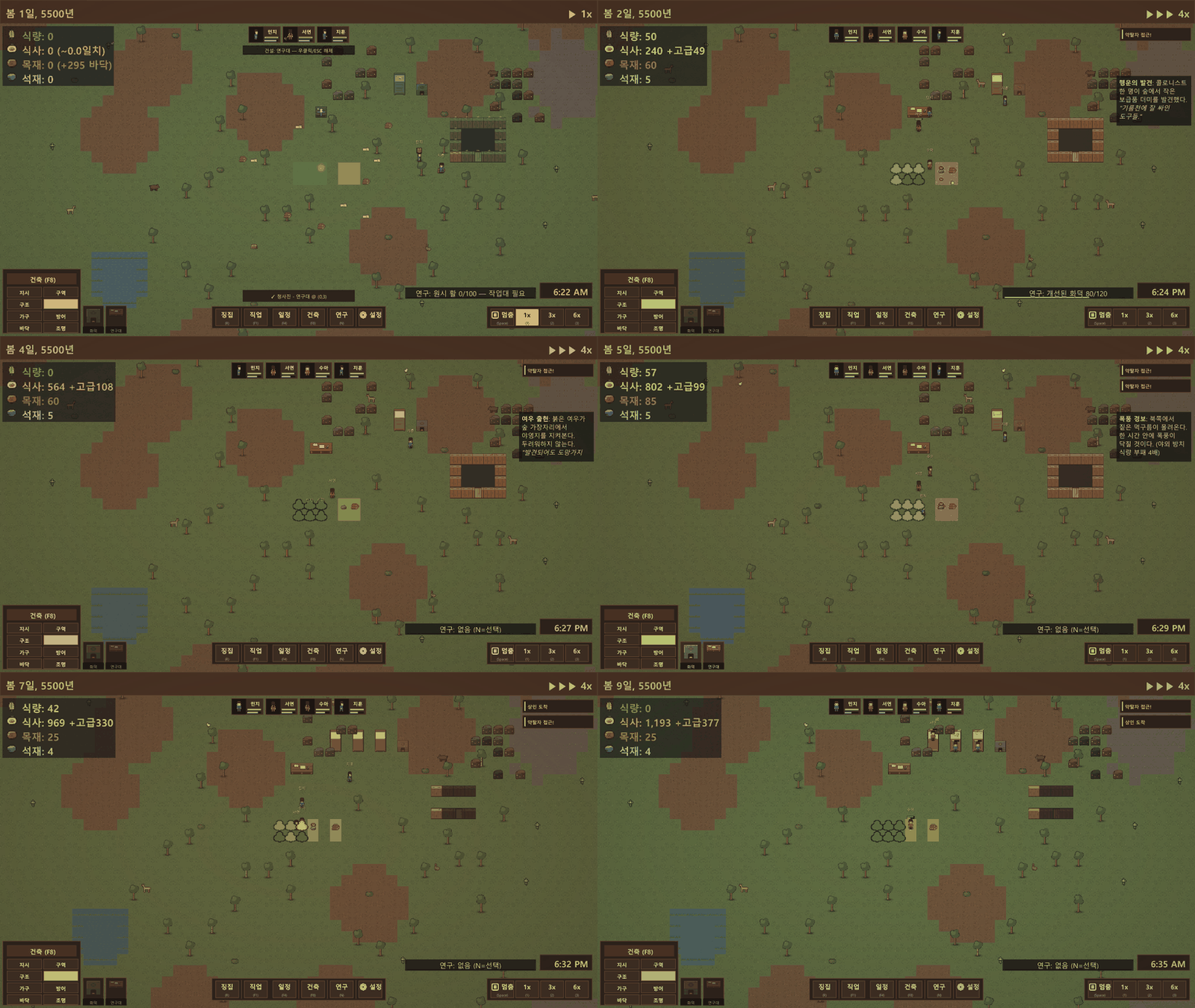
Unattended 16 in-game-day colony soak — agent-built and agent-verified. The loop shown (stockpile → housing → farming → logging → mining) is gated by the 22-scenario input-level repro test and confirmed by isolated-grader rubric verdicts, not the author's claims.
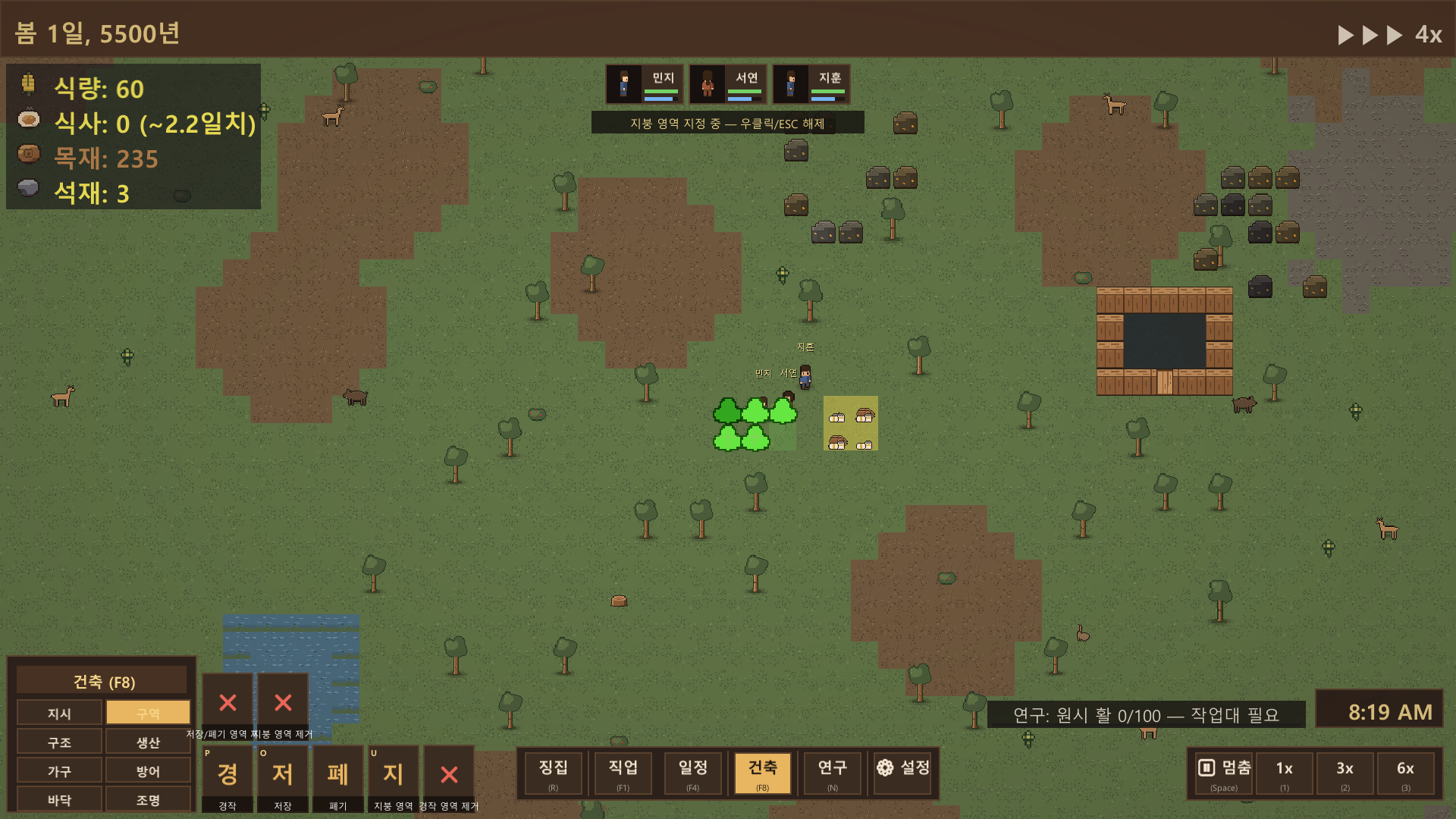
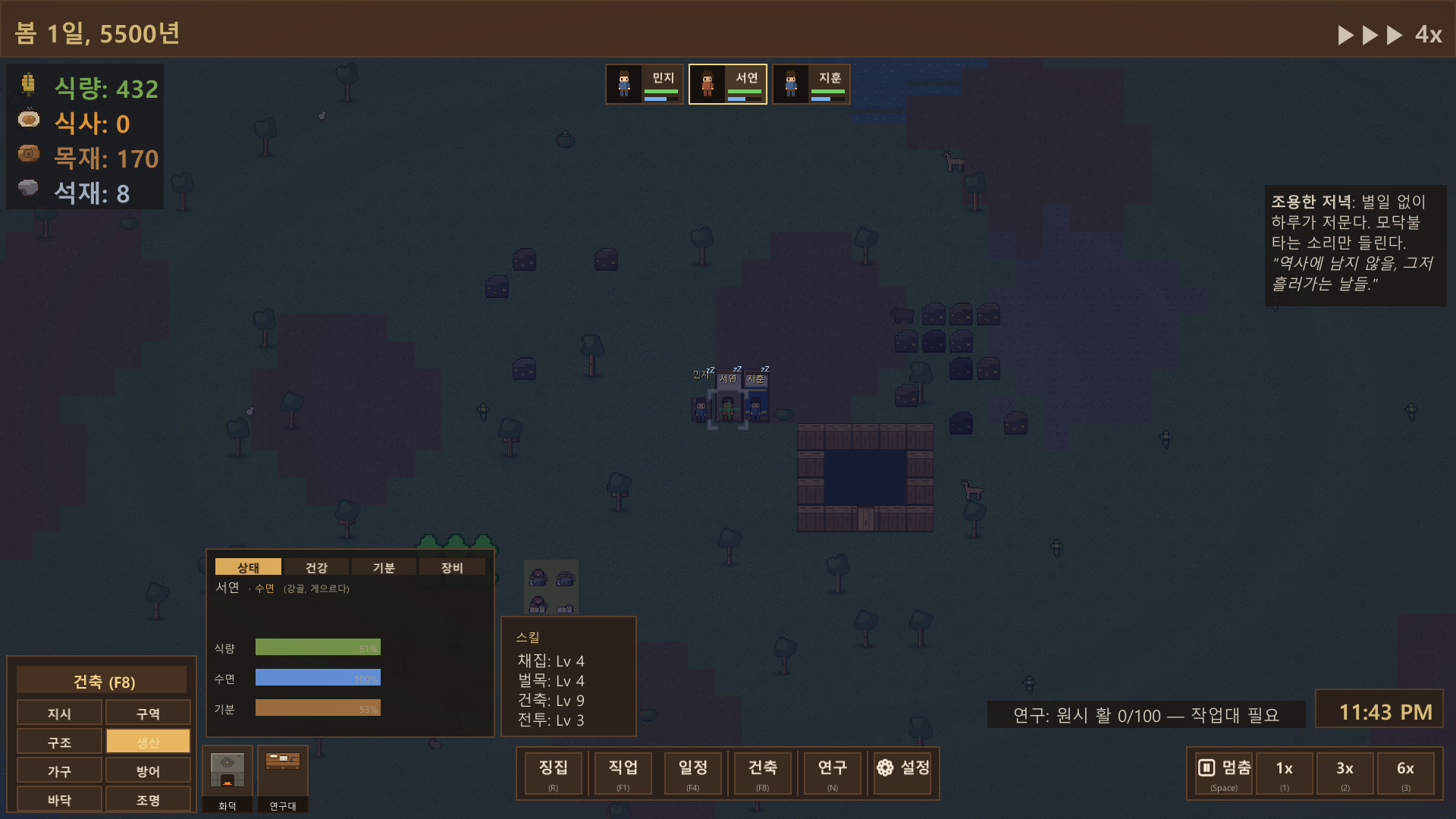
The most active surface right now is PawnSim, a top-down colony-sim vertical slice (Unity 6000.0.75f1 LTS). Every sprite (a full 32px art generation — 3-direction walk/work pawn sheets, animals, terrain, furniture, all procedurally generated), every scene, and every C# system is CLI-scaffolded by the game-dev-agent meta-skill with no manual Unity Editor work — the whole .exe is reproducible from the command line. Colonists chop / mine / farm / cook / haul / build / research / fight under a utility-AI; an AI Director schedules raids on a jittered clock; the player drafts pawns and paints build + designation orders.
The two verification gates — README · PawnSim verification
The headline is verification, not features
The north star is "code existing ≠ verified working." Two layers carry it:
22-scenario input-level repro gate — on every commit, real synthesized clicks run through the same UI path a player uses, with effect assertions: "the click placed the designation," "the wall got built," "only the selected tree was chopped" — not just "the click landed."
Isolated-grader soak loop — long unattended soaks are judged by a separate sub-agent against a written rubric. The grader sees only evidence (screenshots + raw logs), never the author's intent, which blocks author self-grading bias.
A failing gate means no advance: fix-in-place or roll back. The basic colony loop (stockpile → housing with real indoor effects → permanent farm plots → logging → mining → deconstruct) is machine-verified end-to-end, with the grader verdicts committed alongside the fixes.
What the grader caught that self-review missed
The verdicts repeatedly surfaced defects the author's own review passed over — the honest proof the loop is worth its cost:
A silent harness blind spot that had voided every designation in earlier soaks (the verifier itself was broken — "the verifier must be verified too").
A "food-rich colony starving to death" mood-gate trap.
A permanent-mental-break colony freeze.
Honestly tracked open gaps remain — some save/load entity sub-state isn't serialized yet, and the mood economy still runs a slight deficit (the one acknowledged open gameplay problem). Full honest verification status in skills/game-prototype/README.md.
Human-in-the-loop ops
The agent doesn't run open-loop. The operator plays the build, files in-game feedback, and that feedback becomes the next batch of gated fixes — an operator → agent → verify → operator cycle. Logic changes (pawn behaviour, balance) are explicitly operator-gated: the agent drafts the spec and waits for an OK before touching them.
This is the same human-in-the-loop pattern the repo applies to its media missions: the agent does all the mechanical work, the human owns taste, money, and logic approval.
Basic loop verified end-to-end walls + roof · farm plots · stockpile · named colonistsNight cycle three bed tiers · sleep state · night-tint lighting
The meta-skill that scaffolds it: skills/game-dev-agent/. PawnSim is Unity / Windows-primary (the build chain runs the Editor in batchmode); the rest of the repo is macOS / Linux.
Audience · who this is for
Who this is for
You want to see an agent verify the game it builds — not just build it. PawnSim ships with a 22-scenario input-level repro gate on every commit and an isolated-grader rubric loop for long soaks; the graders' verdicts (not the author's claims) are the acceptance record, committed alongside the fixes.
You want short-form vertical video output without writing pipeline code. Give the wizard a music file, get back a 9:16 short with beat-aligned cuts and vintage shaders. No Premiere, no After Effects, no GUI.
You want to study a working multi-agent system that doesn't pretend to be magic. Every commit is one observable step in how the system evolves; docs/audit/ records every drift the auditor catches; the quality + autonomy charts below chart whether those claims hold up over time.
You want to see a Korean job-board digest skill that respects how you actually search — currently parked. Pass --seed "Problem Solver"; the skill expands to the 26 equivalent titles companies use (FDE / Applied AI Engineer / Generalist / Founding Engineer / …) across 11 sources. The KR boards now block scraping, so it runs on mock/dry-run data only; kept in the tree rather than pretending it still ships live.
You want an agentskills.io-compliant Skill you can drop into other runtimes. Both skills work in Claude Code, Cursor, Goose, Gemini CLI, OpenAI Codex, GitHub Copilot, and ~38 other listed compatible runtimes.
If you want a SaaS that hides the pipeline, this isn't it. If you want every step as inspectable bash + open-source local tools (ffmpeg / whisper.cpp / ollama / aubio), it is.
Architecture · how it works
How it works
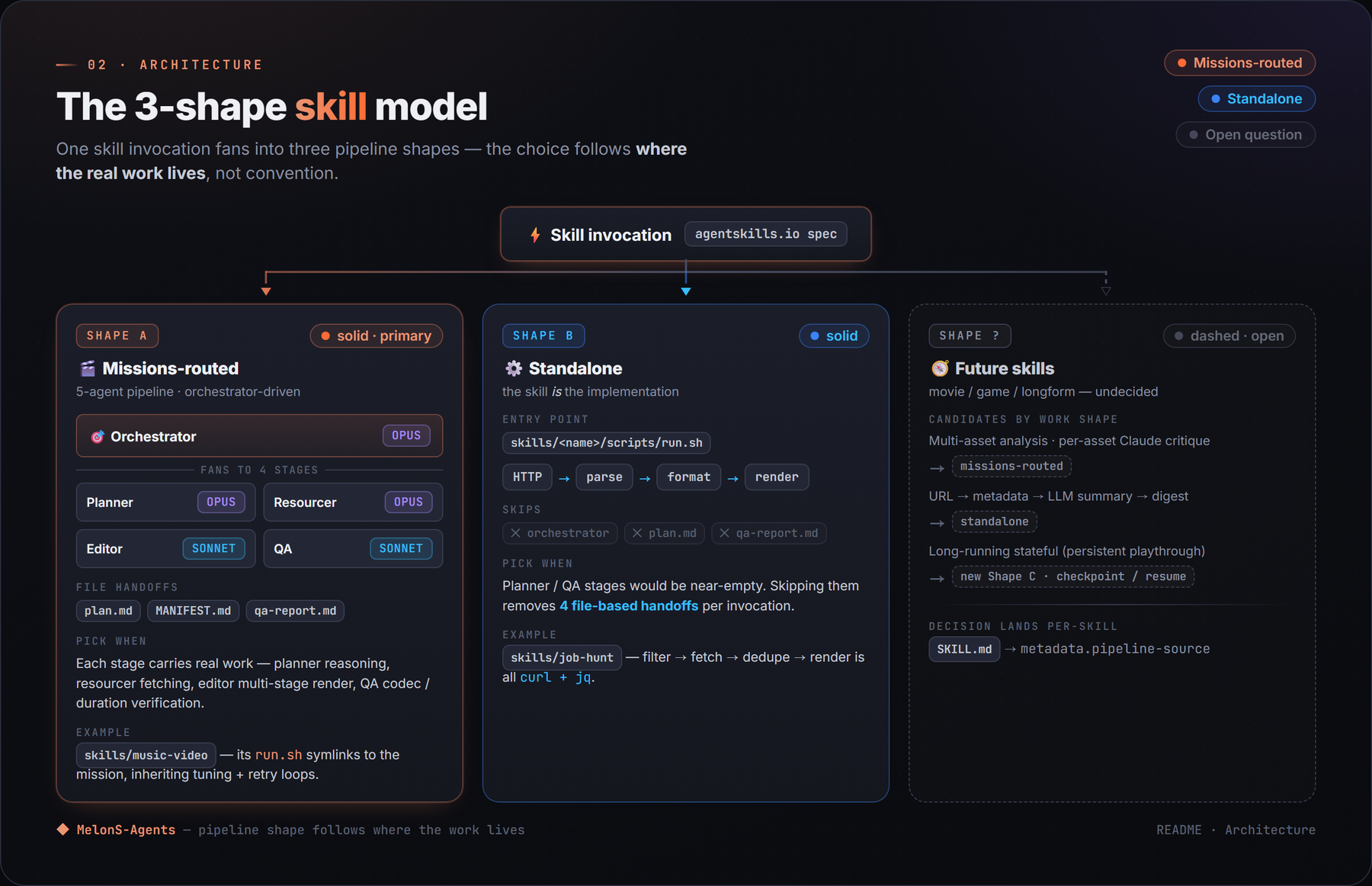
The scaffold is general-purpose — it doesn't force every skill through one shape. Short-form video was the v1 domain (the deliverable is visually verifiable and failure modes are quick to catch); the current development focus is the game track (the PawnSim build-and-verify loop above), driven by a game-dev-agent meta-skill. One production media skill ships today, the music-video mission; the standalone job-hunt skill is parked (KR job boards now block scraping). Earlier missions (faceless-short narration, v1 highlight / shorts-batch) remain in the tree as alternate paths.
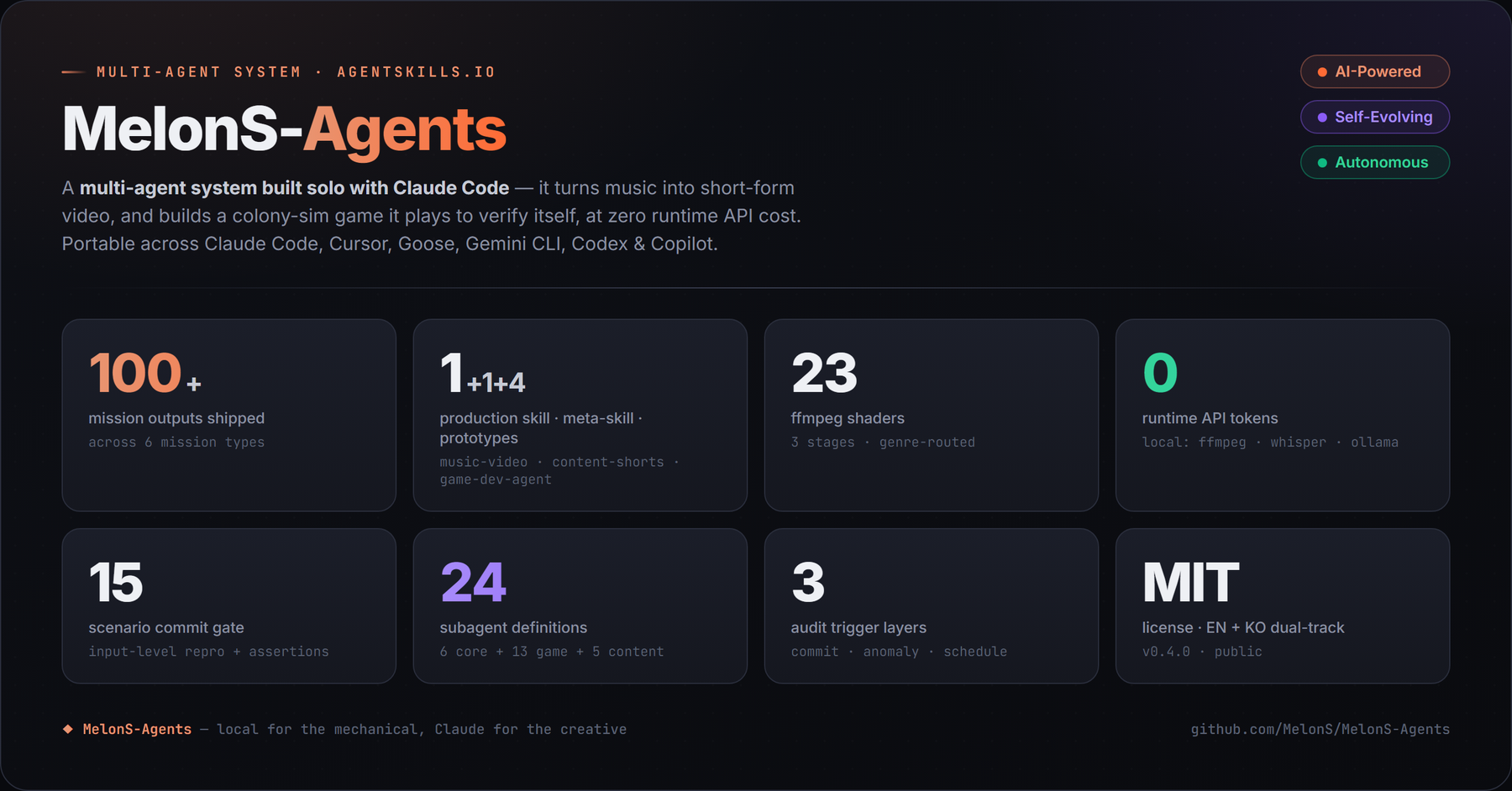
The system at a glance — README · OverviewOne invocation, three pipeline shapes — README · Architecture
— Game track · the current focus
game-dev-agent (meta-skill, Skill #3)
A Unity-focused agent that CLI-scaffolds a whole game with no manual Editor work: sprite generation (32px procedural art), C# system scaffolding, scene + prefab generation via Unity batchmode, balance tuning, audio generation, and an in-game AI Director. It drives four prototype skills that double as its empirical validation surface — PawnSim (colony-sim flagship), plus a 2D physics-merge puzzle, a wave-survival action game, and a sliding-tile number puzzle — each built faster than the last, testing the "compounding speedup" hypothesis.
The game track runs a separate roster of 13 game-domain sub-agents (director / designer / programmer / build-engineer / QA / artist / sound / narrative / specialists) on top of the 6 core media-pipeline agents, 5 for the content-shorts pipeline, and 3 judges that score a plan, a still, and a rendered cut — 27 agent definitions total in .claude/agents/.
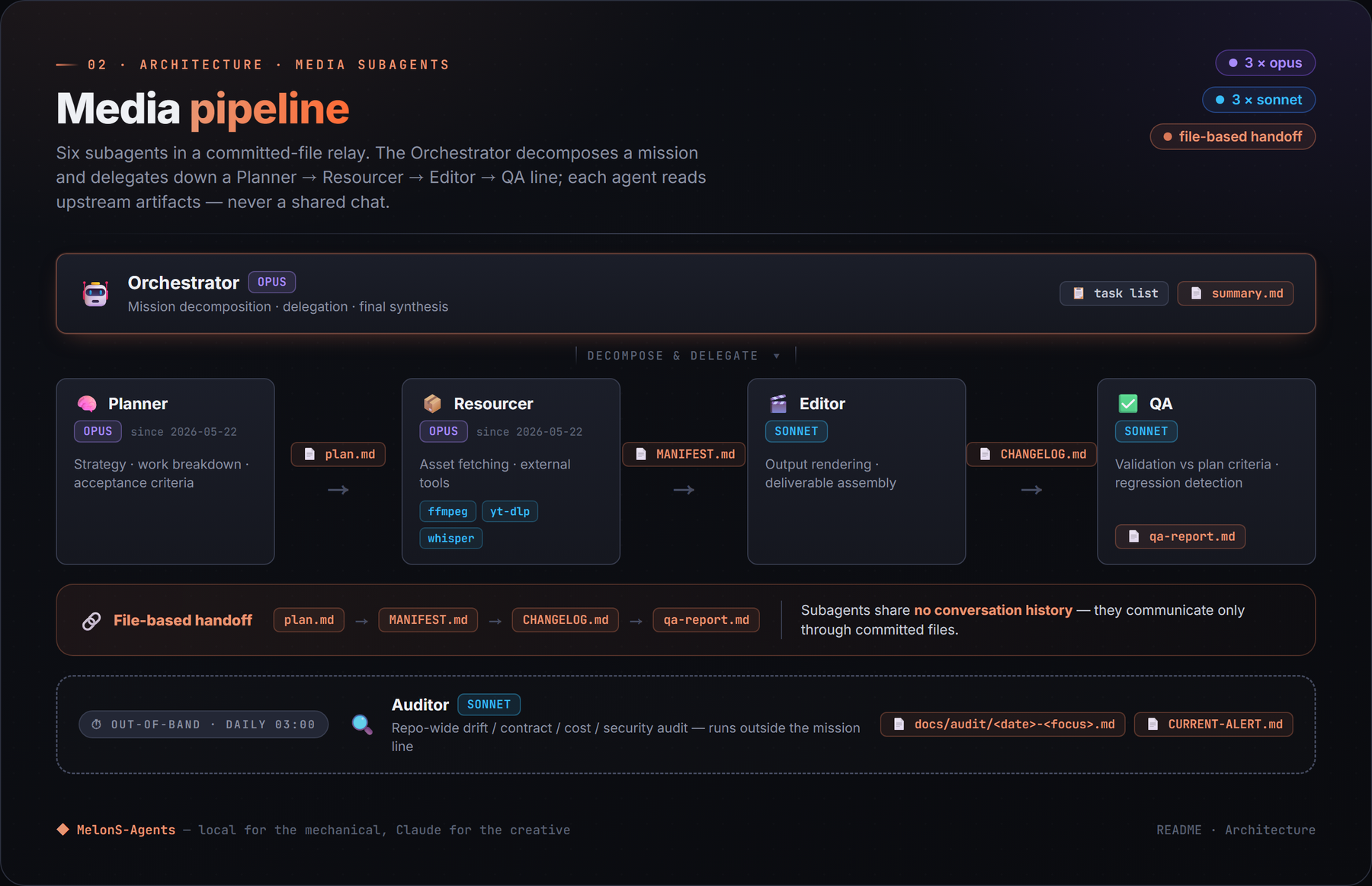
— Media pipeline · music-video mission
Six subagents, file-based handoff — README · Architecture
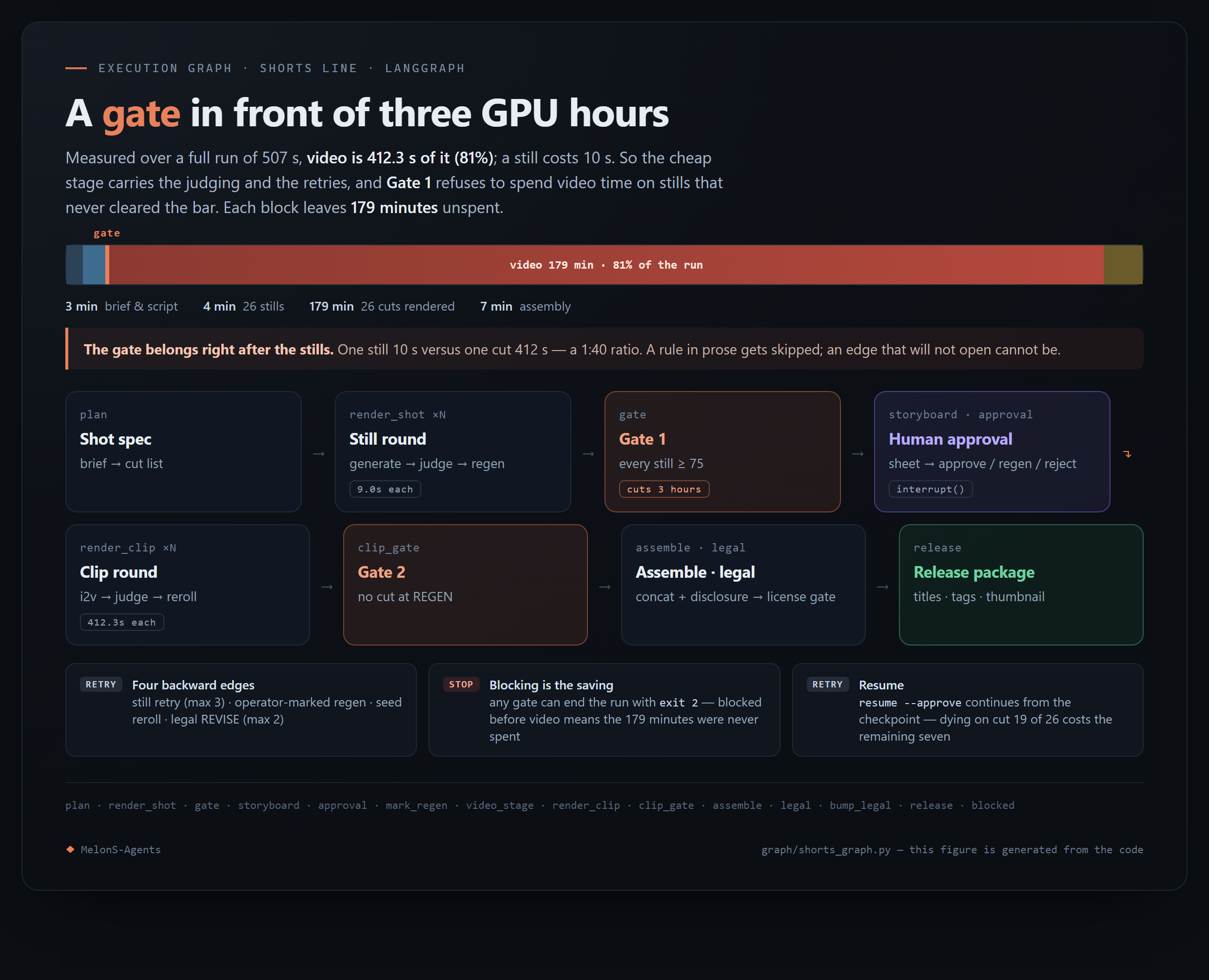
— Execution graph · shorts production (LangGraph)
Shorts production graph — a gate in front of the expensive stage (412 s per cut) · rendered from the running graph
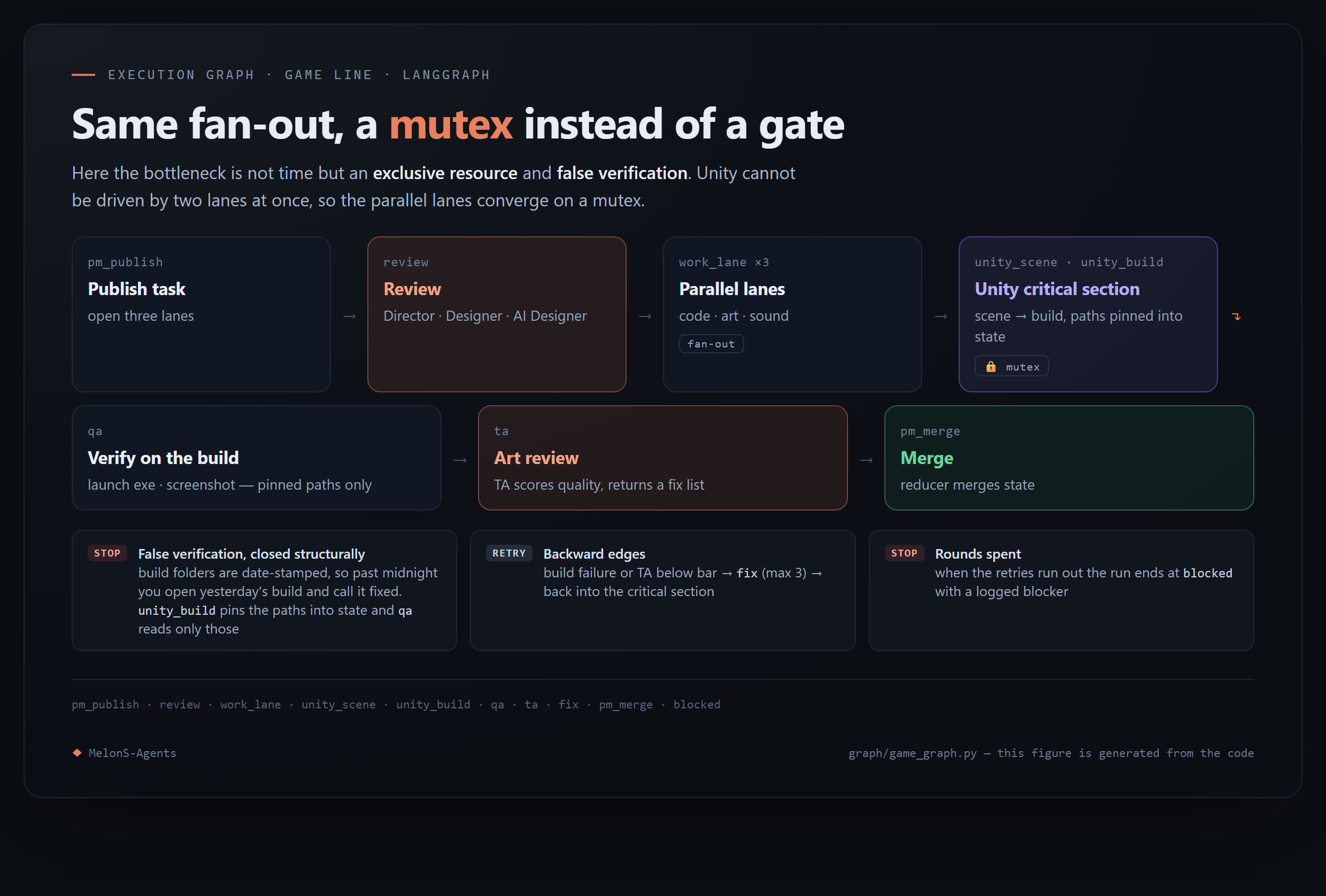
— Execution graph · game production (LangGraph)
Game production graph — parallel lanes join on a mutex, not a gate · rendered from the running graph
Pipeline (music-video mission)
Beat extraction.aubiotrack finds real beats; sub-beat noise rejected. Cuts land every Nth beat (default 12 — about one cut per 7.5 s at 95 BPM).
Phrase alignment.aubioonset detects drum hits. Variable per-clip setpts by mood: slow scenes 0.55×, ambient 0.70×, active 0.80×, natural 1.00× — the music drives the visual pace.
B-roll. Mood-keyword Pexels Videos API fetch; per-window selection. Demo mode bundles CC-BY Blender open-movie clips for zero-key first-touch.
Glitch micro-edits. 0.2 s reverse + 0.2 s forward jump-cut on detected drum onsets, but only on clips classified as static-camera so the frame doesn't shake during the glitch.
Vintage lo-fi shaders. Film grain + vignette + Gaussian zoom-pulse + phrase-aware pond ripple + halation bloom. All pure ffmpeg filter graphs — no GLSL, no external renderer.
Render + QA. ffmpeg 9:16 screen-fill, mission-level retry on failure.
Quality bar — 5 contracts the system now enforces
The 2026-05-22 music-video QA pass surfaced six taste directives that the prior pipeline produced quietly broken output against. Five landed as enforced contracts; the sixth is open as a research direction. Case study #9 writes the framing: the bug wasn't the renders, it was that the contracts weren't expressible in code.
All pure ffmpeg filter graphs. No GLSL, no external renderer. Catalog in scripts/music-video-shaders.sh; per-genre routing in skills/music-video/data/genre-presets.yaml.
Stage 1 — first pass (2026-05-17).pond, halation, breathing, combo.
Deliberately deferred — cel-shading / cartoon (needs GLSL / EbSynth / AI stylization). See case study #5.
— Audit & cost · the self-watching repo
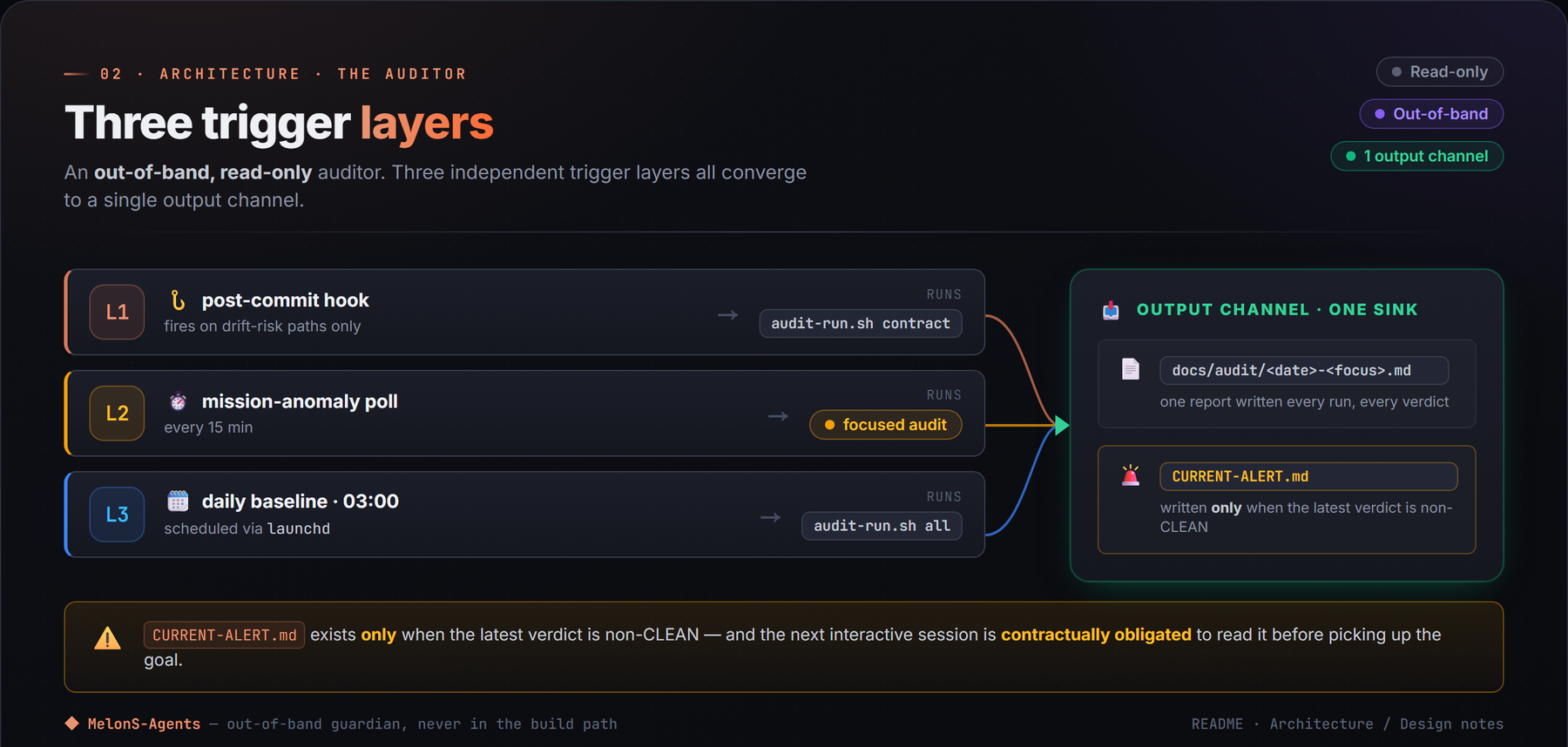
Three trigger layers, one output sink — README · Architecture / Design notes
Three-layer reactive audit
L1 — post-commit hook. Drift-risk commits (anything under agents/, .claude/agents/, config/, CLAUDE.md, the operator contract) fire audit-run.sh contract within ~30 s.
L2 — 15-min mission-anomaly poll. New blocker files or QA-FAIL bursts trigger a focused audit. No-op (zero tokens) when nothing's wrong.
L3 — daily 03:00 baseline. launchd fires the full sweep. Catches anything L1 + L2 missed.
The pattern is Reactor + Hook (files as events), not Observer — subagents in this repo aren't long-running observables.
Cost-routing rule
The architectural lesson from a real failure: applying "Tier 2 (local) = default" to every pipeline stage produces a quality ceiling.
Mechanical, high-volume stages (transcribe, render, fetch, beat-detect) — local. Token cost would be ruinous at scale.
One-shot creative stages (script hook, factual framing, mood-keyword extraction) — Claude. ~500 tokens per call, operationally negligible against the existing subscription quota, and quality compounds over the next 60 seconds of viewing.
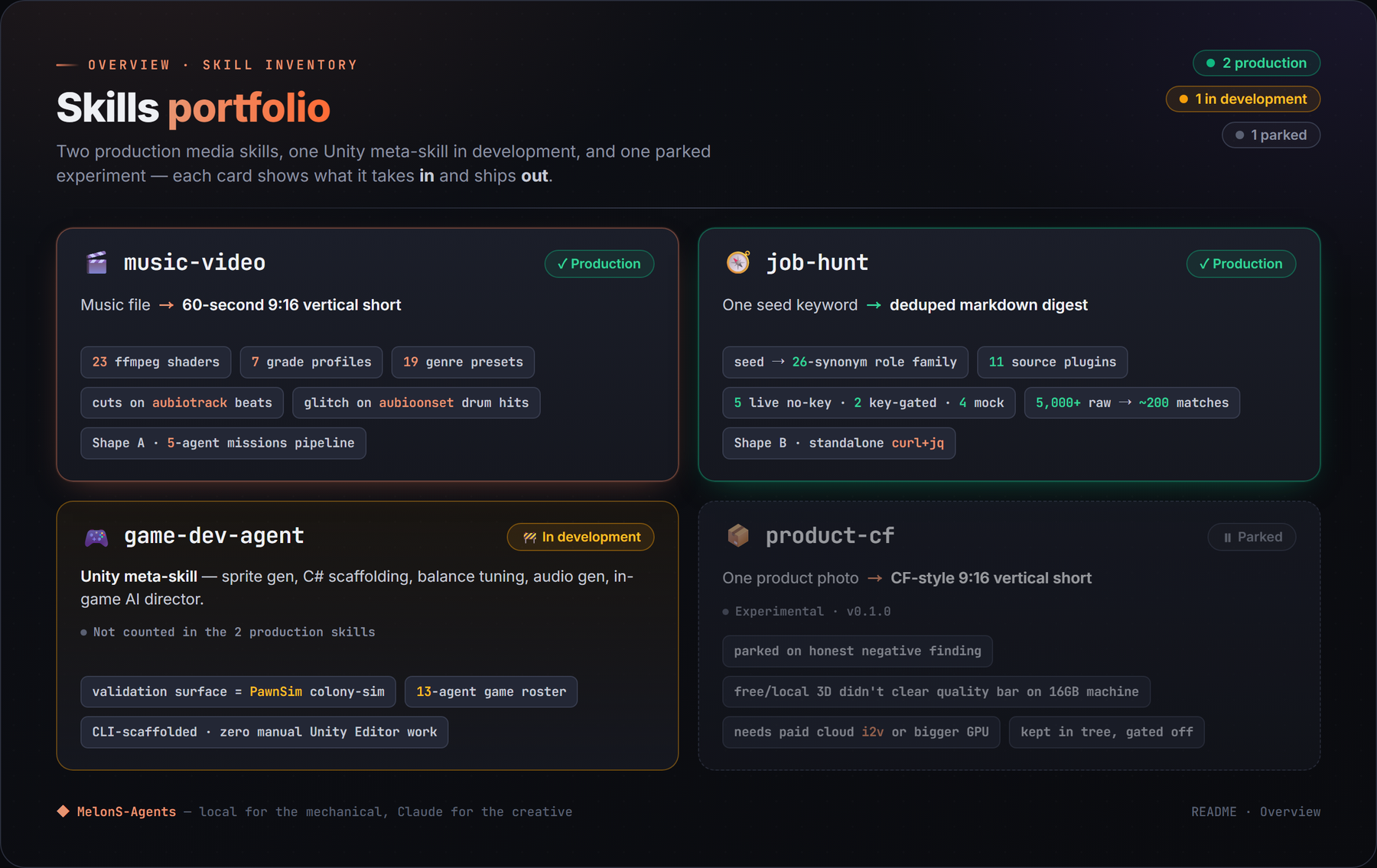
Skills portfolio — what each skill takes in and ships out — README · Overview
🎬music-video✓ Production
Music file → 60-second 9:16 vertical short
23 ffmpeg shaders
7 grade profiles
19 genre presets
cuts on aubiotrack beats
glitch on aubioonset drum hits
Shape A · 5-agent missions pipeline
Skill #1, missions-routed; verified via a 12/12 Hermes drop-in interop test. Spec: skills/music-video/
🧭job-huntParked
One seed keyword → deduped markdown digest
seed → 26-synonym role family
11 source plugins
5 live no-key · 2 key-gated · 4 mock
5,000+ raw → ~200 matches (mock run)
Shape B · standalone curl+jq
Skill #2, standalone, v2 short-keyword UX — parked: the KR job boards it targeted (Saramin, Wanted, JobKorea…) now block scraping, so it runs on mock/dry-run data only; the global-* ATS/RemoteOK/Remotive/HN plugins may still return live remote postings. 70 tests; 4 enrichment utilities behind JH_*_LIVE flags. Spec: skills/job-hunt/
🎮game-dev-agentIn development
Unity prompt → CLI-scaffolded game
validation surface = PawnSim colony-sim
13-agent game roster
zero manual Unity Editor work
not in the 2 production skills
Skill #3, the meta-skill above — sprite gen, C# scaffolding, balance tuning, audio gen, in-game AI Director.
Pipelines are packaged as portable Skills following the open agentskills.io standard — a skill written once can target multiple compatible runtimes (Claude Code, Cursor, Goose, Gemini CLI, OpenAI Codex, GitHub Copilot, etc.).
Skill #2 — job-hunt, in depth
A separate-shape skill: standalone (no missions-routed pipeline), v2 short-keyword UX, agentskills.io-compliant. Parked — the KR job boards it targeted (사람인 / 잡코리아 / 원티드 / 프로그래머스) now block scraping, so the live digest never came together; it runs only on mock/dry-run data. Pass --seed "Problem Solver" and the orchestrator expands to a 26-synonym role family (Forward Deployed Engineer / Applied AI Engineer / Generalist / Founding Engineer / …). A mock run de-dups 5,000+ raw postings down to ~200 matches; the code stays in the tree.
11 source plugins (5 live-ready without a key, 2 key-gated, 4 mock-fallback) — all mock-fallback by default; live HTTP per-plugin behind JH_SOURCE_LIVE=1.
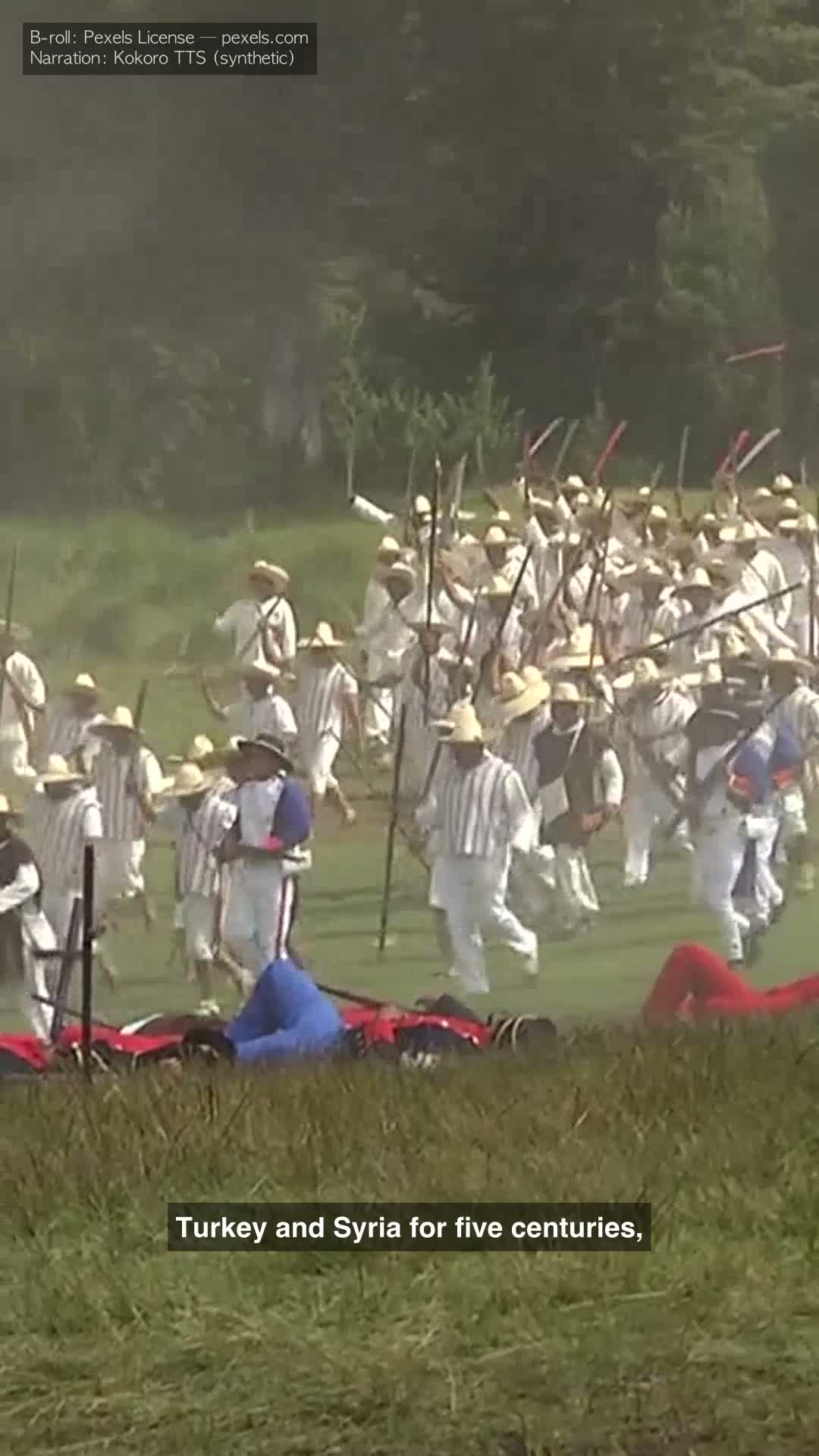
The earlier faceless-short mission still lives in the tree. Topic prompt in, narrated 60-second short out: Sonnet drafts the hook + factual framing, Kokoro-ONNX (English) or macOS Yuna (Korean) synthesizes voice, whisper.cpp transcribes for caption timing, Pexels B-roll selected per-window from caption keywords, ffmpeg burns single-line captions. Preserved for topic-driven content; not the current production format.
outputs/review-queue/ + 3 scripts — batched taste-decision queue. Operator drains a contact-sheet markdown on their cadence, ~10× fewer intervention events.
A meta-skill, goal-lock, parses docs/goal.md and reports unchecked deliverable subgoals so long autonomous sessions can re-anchor. Full per-tool table: docs/operator-tooling.md.
Evidence · what it produces
Evidence — what the pipeline actually produces
Frames captured from rendered mp4s. Full mp4s live under records/missions/ (gitignored — each ~ 25–50 MB).
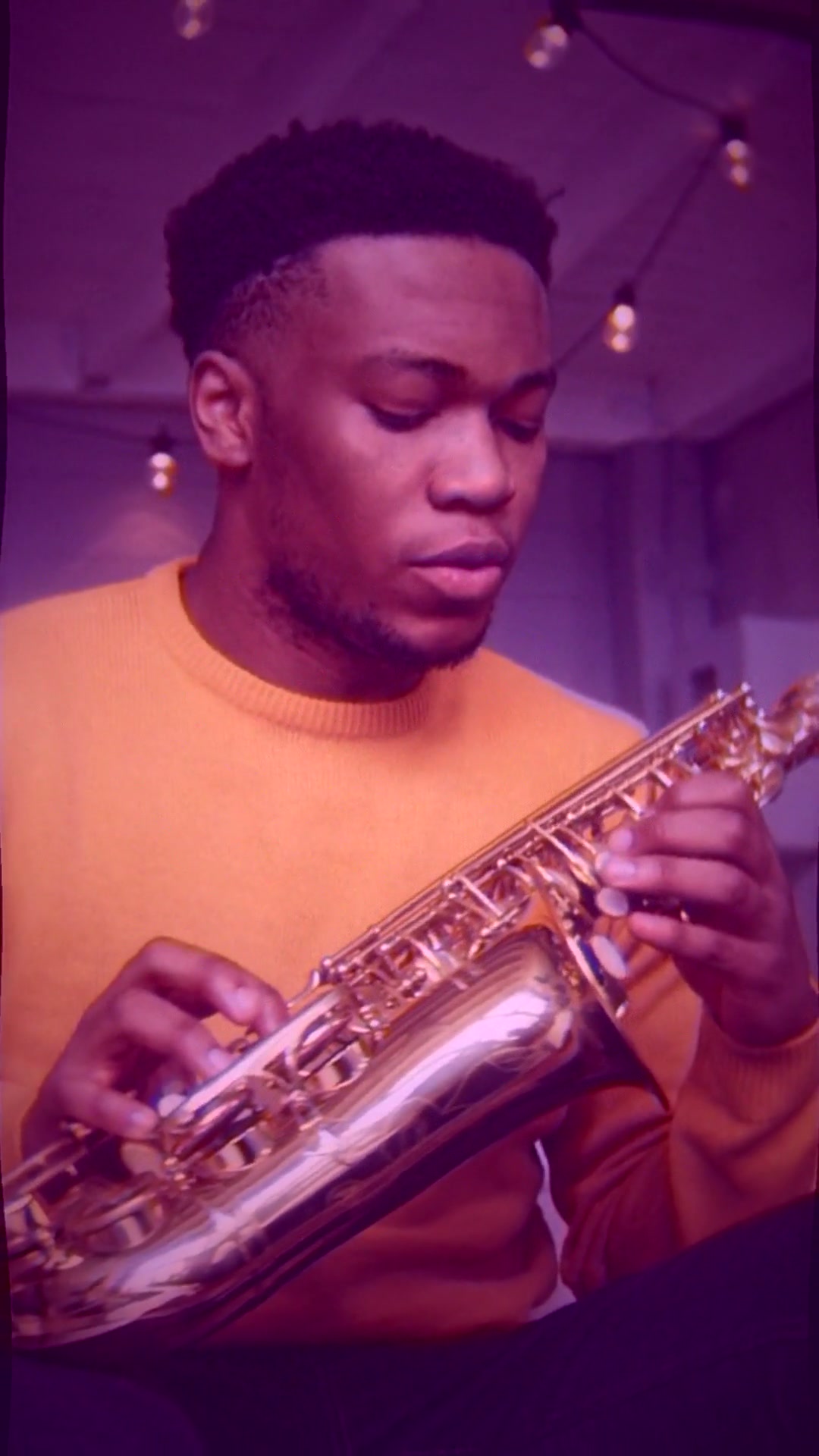
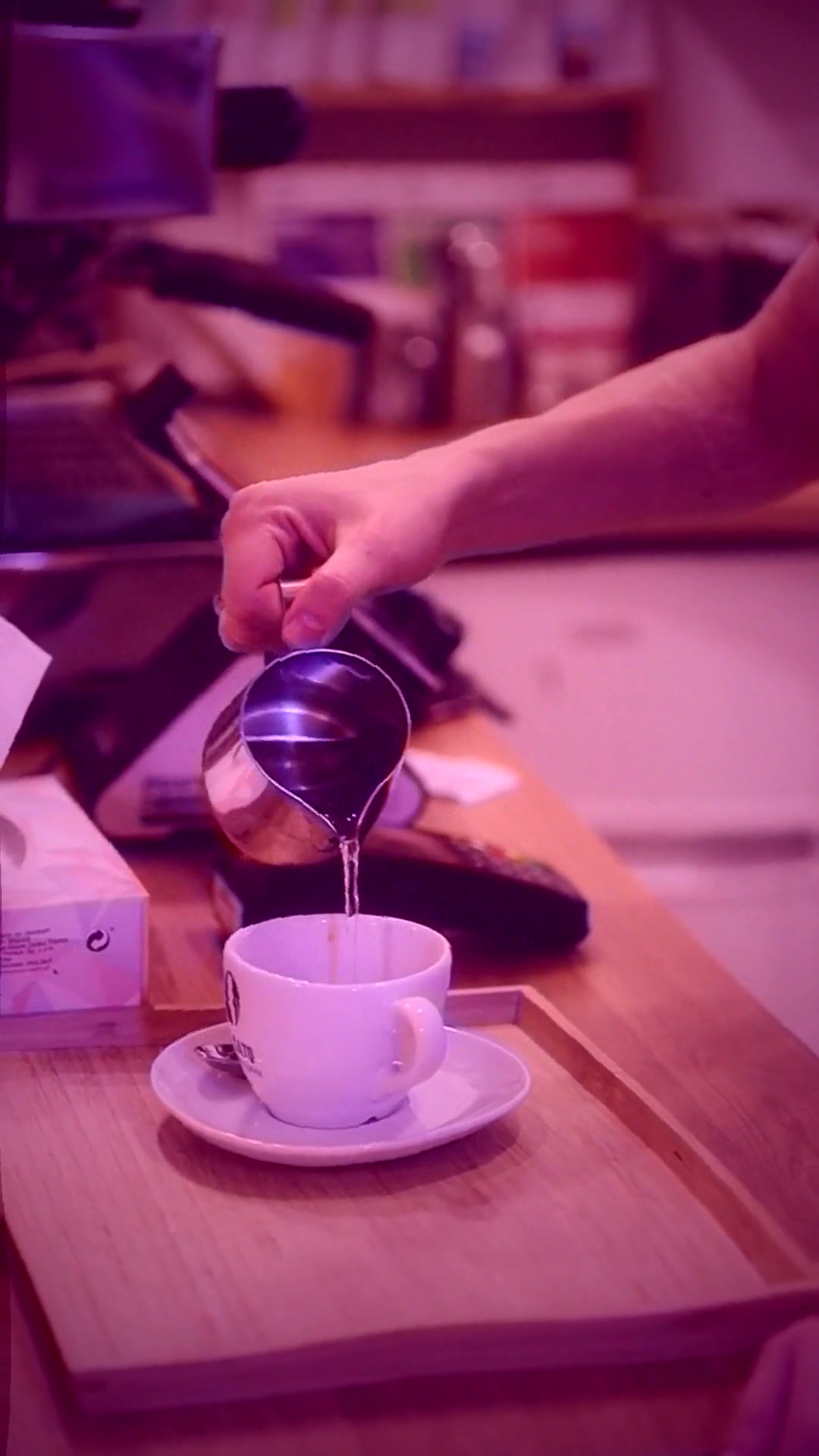
music-video noir-detective — 2026-05-22 batch, t = 30 s. Per-genre grade_profile (rnb_low_key) shapes the pink-magenta low-key look; phrase-aware shader stack on top.
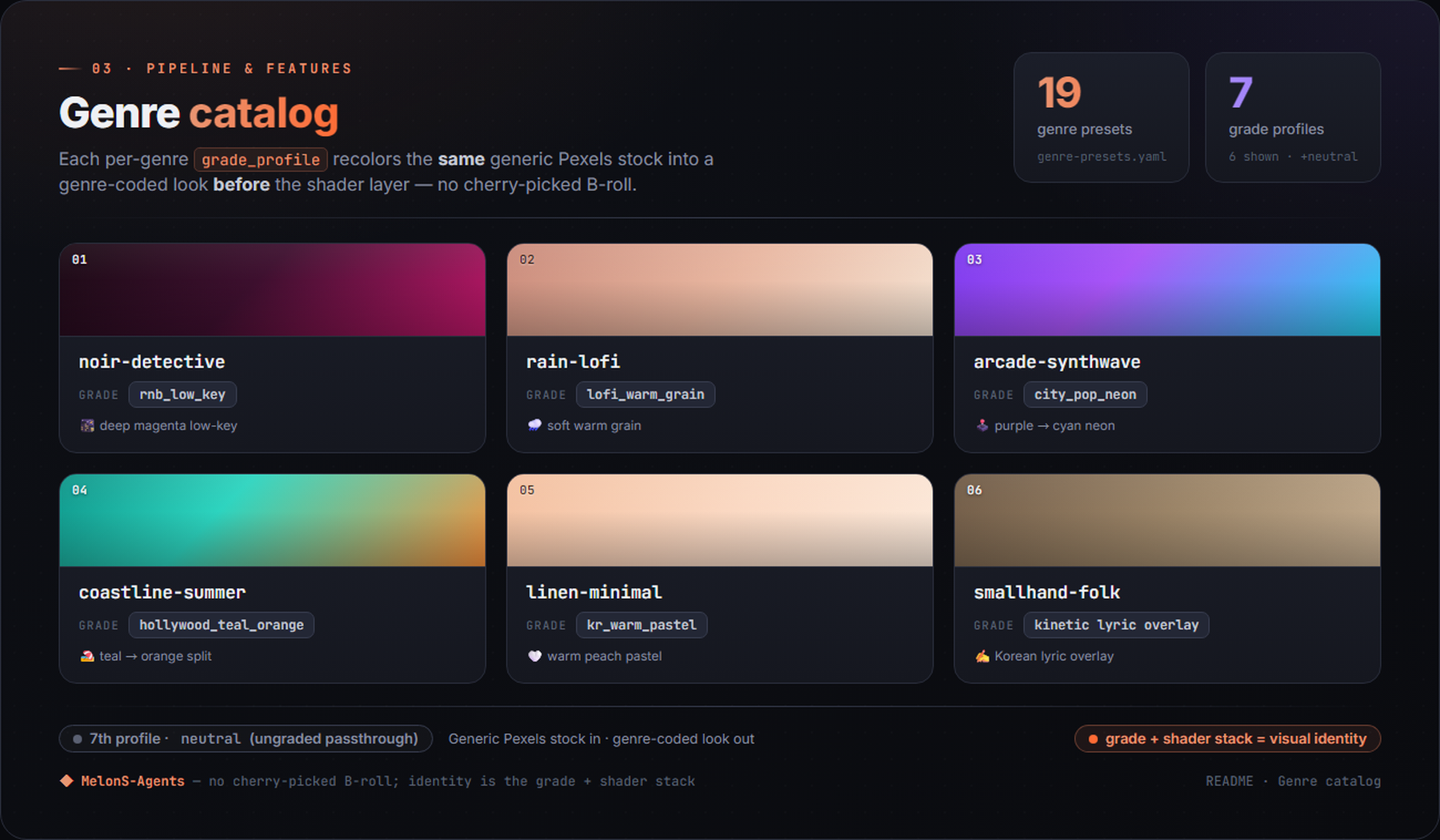
Genre catalog at a glance — six of the seven grade profiles
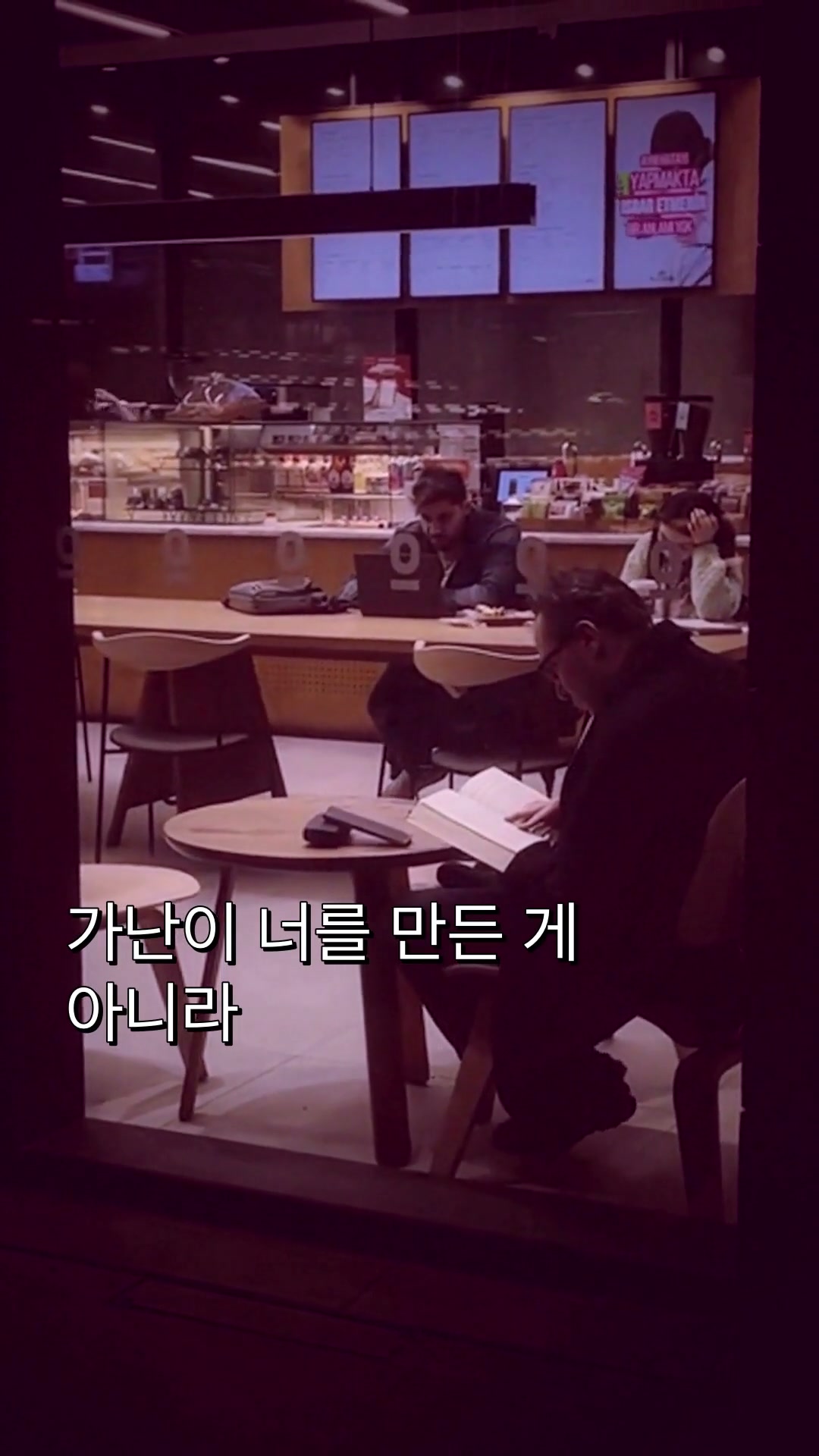
Mid-climax frames from the 2026-05-20 → 2026-05-23 production batch. No cherry-picked B-roll — every clip came from the same unattended Pexels mood-keyword fetch the pipeline always runs. The visual identity is the grade_profile + shader stack, not the source footage. Seven grade profiles compiled to ffmpeg filter graphs via scripts/music-video-grade.sh (six shown below); 19 genre presets in skills/music-video/data/genre-presets.yaml.
Same stock in, genre-coded look out — README · Genre catalog
Single seed keyword in, deduplicated markdown digest out. The mock-fallback rendering below comes from docs/samples/job-hunt-digest-mock.md — exercised against all five default sources, 26-synonym problem-solver family expansion, 7/21 raw postings matched. Real digests land under records/jobs/<date>/digest.md (gitignored).
# Job-hunt digest — 2026-05-20

> Seed: Problem Solver → role family problem-solver
>            (26 synonym keywords expanded)
> Sources: _mock, kr-wanted, kr-programmers, kr-jobkorea, kr-saramin
> Total postings: 7 — 0 new since last digest

### _mock (3)
- Problem Solver (AI Agent) · MockRebeatLike
  지역: 서울 강남구 · 게시: 2026-05-20
  요약: 쇼핑 AI Agent 기획+개발+배포까지 직접 담당.  PMF 탐색 사이클 주도.
- Forward Deployed Engineer · MockFrontierAI
  지역: 원격 · 게시: 2026-05-20
  요약: Build AI agent solutions; framing problems → shipping LLM
        prototypes within weeks.
- Generalist · MockKRStartup
  지역: 서울 마포구 · 게시: 2026-05-19
  요약: PM+Engineer+Data Analyst 하이브리드.  Ship MVPs, iterate to PMF.

### kr-wanted (1) · kr-programmers (1) · kr-jobkorea (1) · kr-saramin (1)
…
Frames from the earlier faceless-short trials, retained as visual evidence of the narration-era pipeline that preceded the music-video pivot.
Hittites ENHydrogen ENAutoTune ENHittites KO
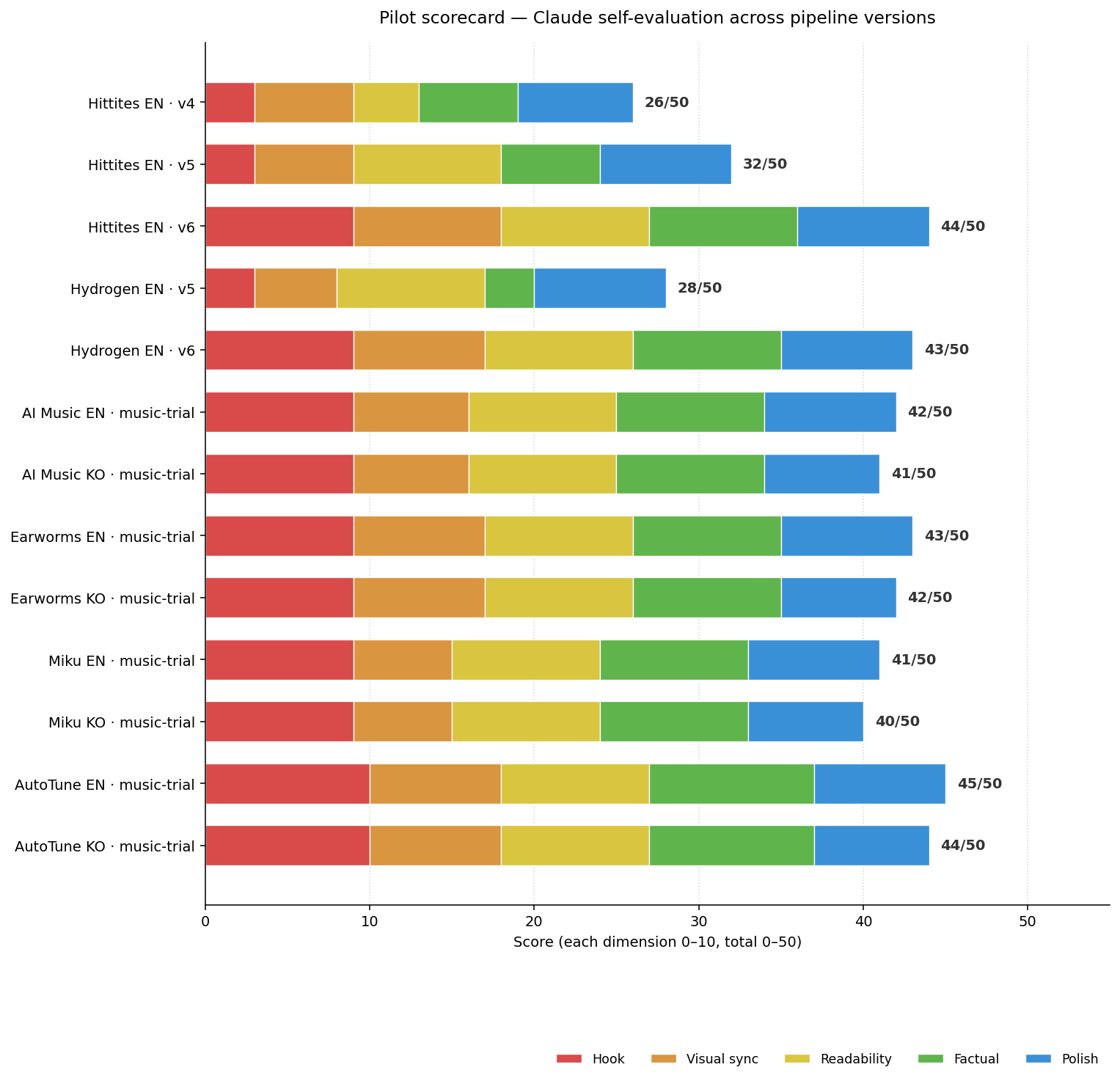
Faceless-era scorecard historical
Self-evaluation across five retention-mapping axes (Hook, Visual sync, Readability, Factual coherence, Production polish), assigned by Claude during the faceless-short iteration — preserved as the structured progress signal from the v4 → v5 → v6 sequence that preceded the music-video pivot. The music-video mission uses platform watch-time data instead of per-dimension scoring; per-video metrics live under docs/pilots/.
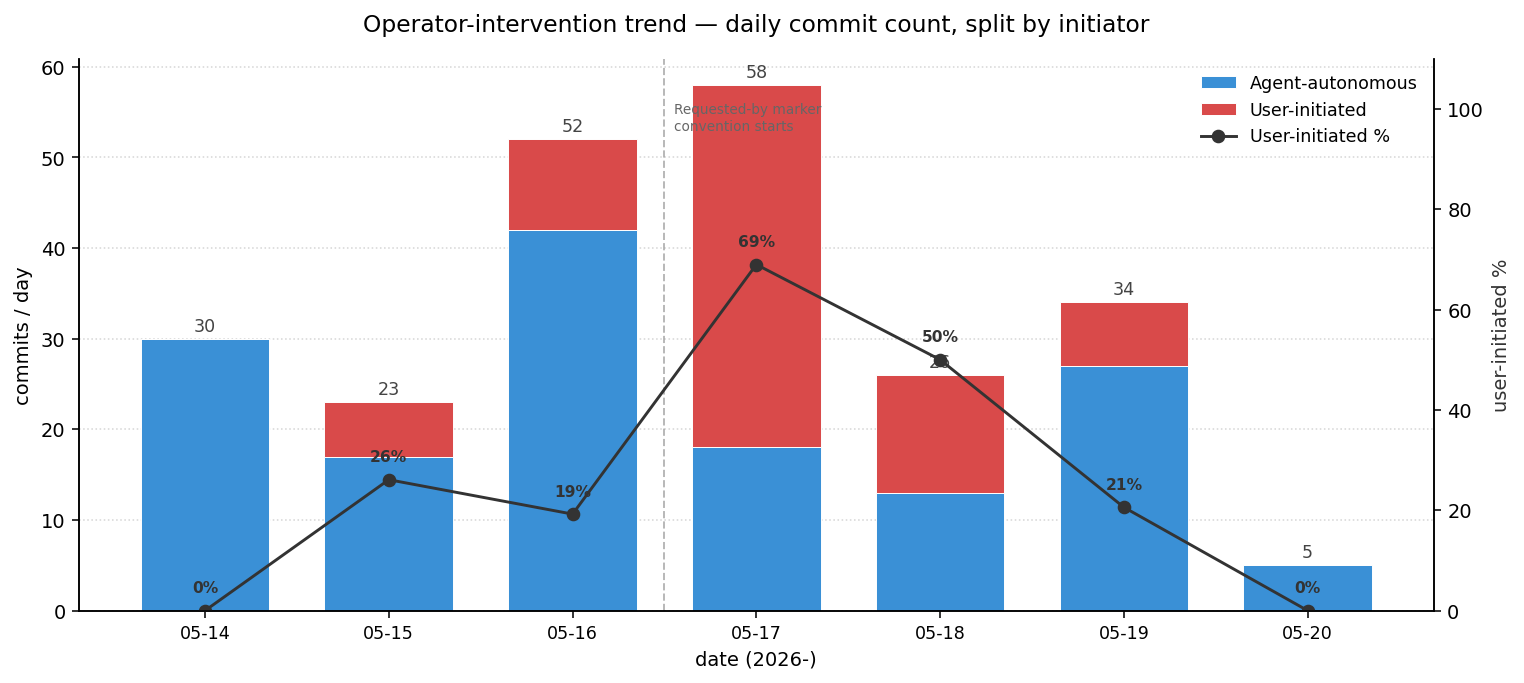
Operator-intervention trend (autonomy signal)
A multi-agent system that needs constant human steering hasn't actually replaced the work it was meant to. Two-panel honest signal updated daily 02:00 KST — Panel A from git log (commit attribution + leverage ratio), Panel B from local Claude Code session JSONLs (operator prompt count + active session minutes). See case study #8 for the 5 prioritized reduction levers acting on the trend.
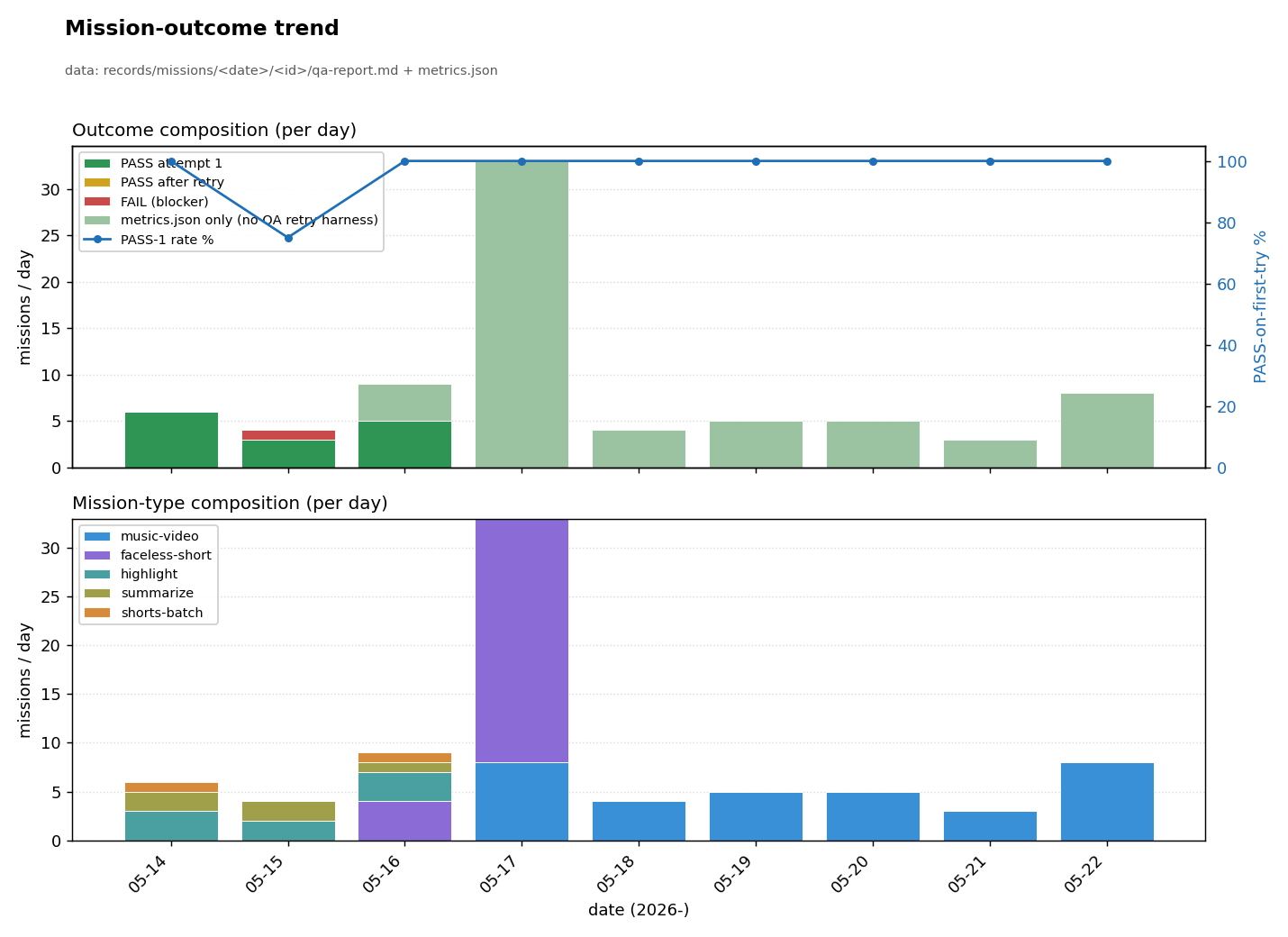
Historical (render-era) chart, last refreshed 2026-05-25. Since 2026-06 the active development focus shifted to the PawnSim game track, whose work shows up as verification-gated commits (see the autonomy trend above) rather than render missions — so this chart is no longer the current signal and is kept as a record of the render era, the same way the scorecard above is framed. It reads the system's render evolution at a glance: the 2026-05-17 spike (8 → 33 missions/day) is the faceless-pilot batch; the post-pivot flat band is the music-video format at a sustainable 3–8 renders/day cadence. Every records/missions/<date>/<id>/qa-report.md was parsed for Verdict: PASS|FAIL and attempt N of M.
Quickstart · try it
Try it in ~60 seconds
Single-command guided wizard. No Pexels signup, no Suno round-trip, no .env edit:
git clone --depth 1 https://github.com/MelonS/MelonS-Agents.git
cd MelonS-Agents
./scripts/first-touch.sh        # checks prereqs, fetches cache, renders, opens result
The wizard checks prerequisites, fetches the demo cache (~30 s), renders a 60-second 9:16 short from bundled CC-BY Blender clips + Kevin MacLeod tracks (~100 s), and opens the result. Single Y/n; rest is automatic.
Skill #2 — job-hunt short-keyword demo (~5 s, no network)
skills/job-hunt/scripts/run.sh --seed "Problem Solver" --dry-run
# digest.md printed on stdout; mock-fallback postings spanning multiple
# sources, all matched against the 26-synonym "problem-solver" family.
Live HTTP per source (5 plugins require no API key): JH_GLOBAL_ATS_LIVE=1 JH_GLOBAL_REMOTEOK_LIVE=1 JH_GLOBAL_REMOTIVE_LIVE=1 JH_GLOBAL_HN_LIVE=1 JH_WORKNET_LIVE=1.
Full Pexels + Suno path (mood-keyword catalog, custom tracks) documented as the advanced path in the README Quick start. macOS first; Linux compatible for the core pipeline (whisper.cpp + ollama + ffmpeg + aubio), macOS-only for launchd schedulers and Yuna TTS.